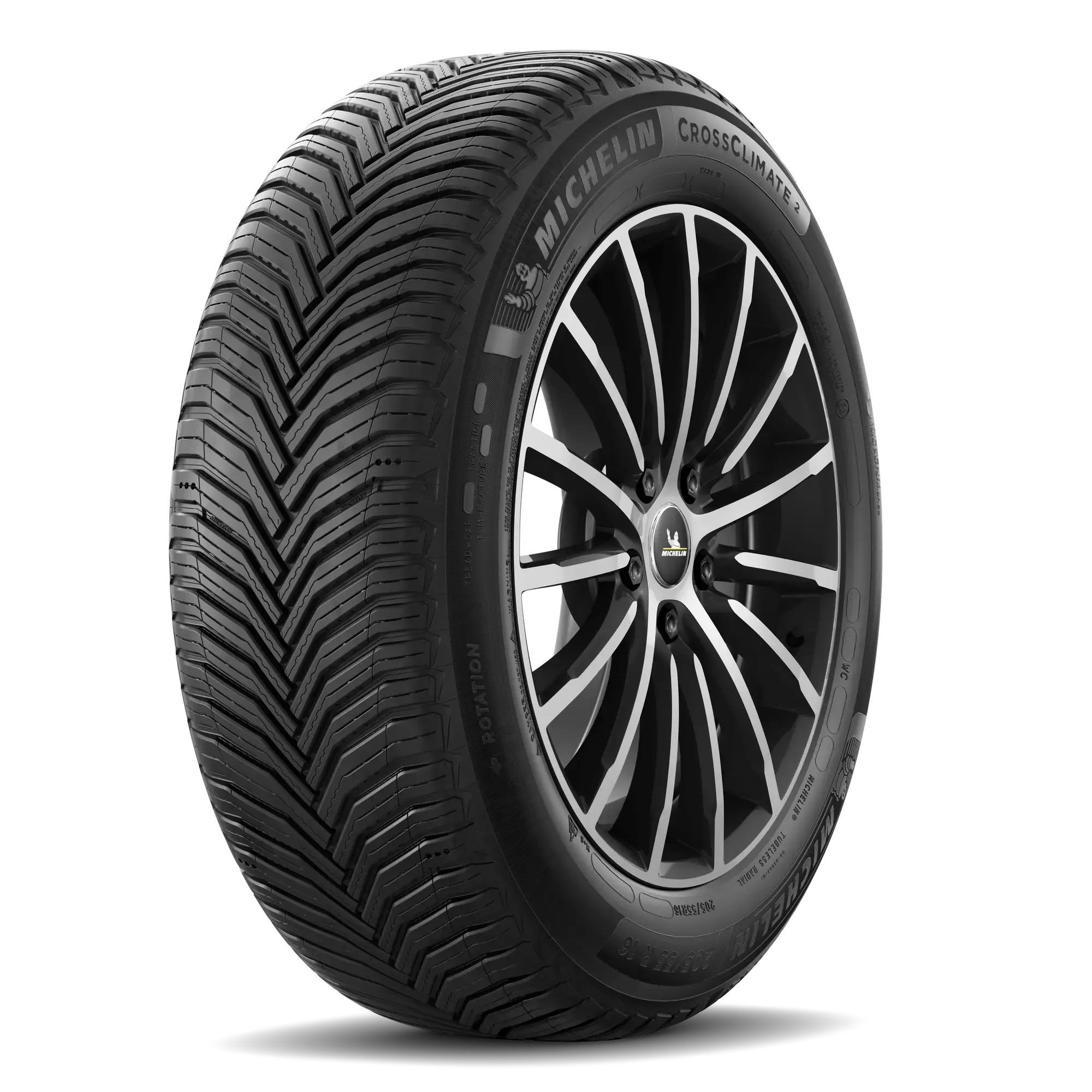
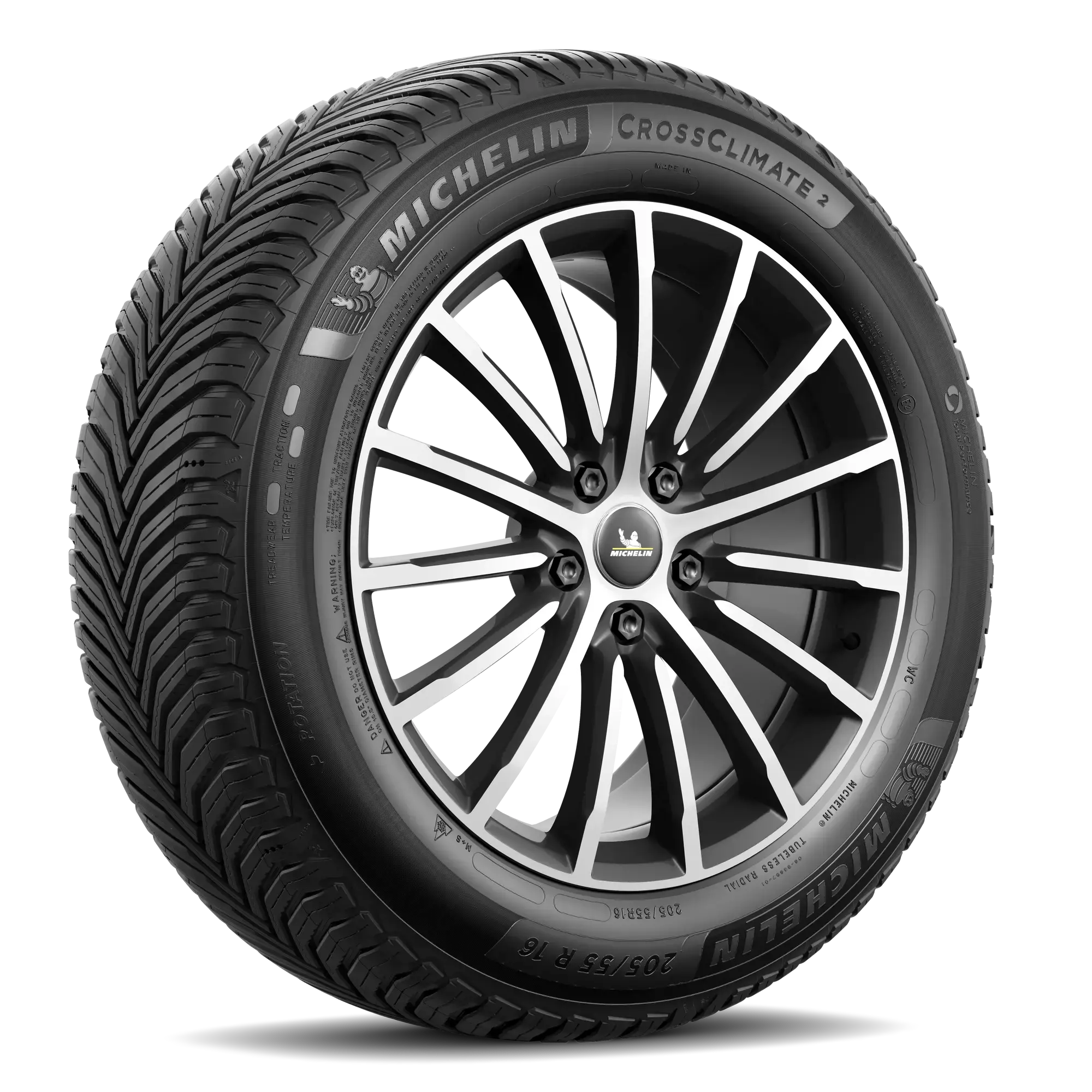
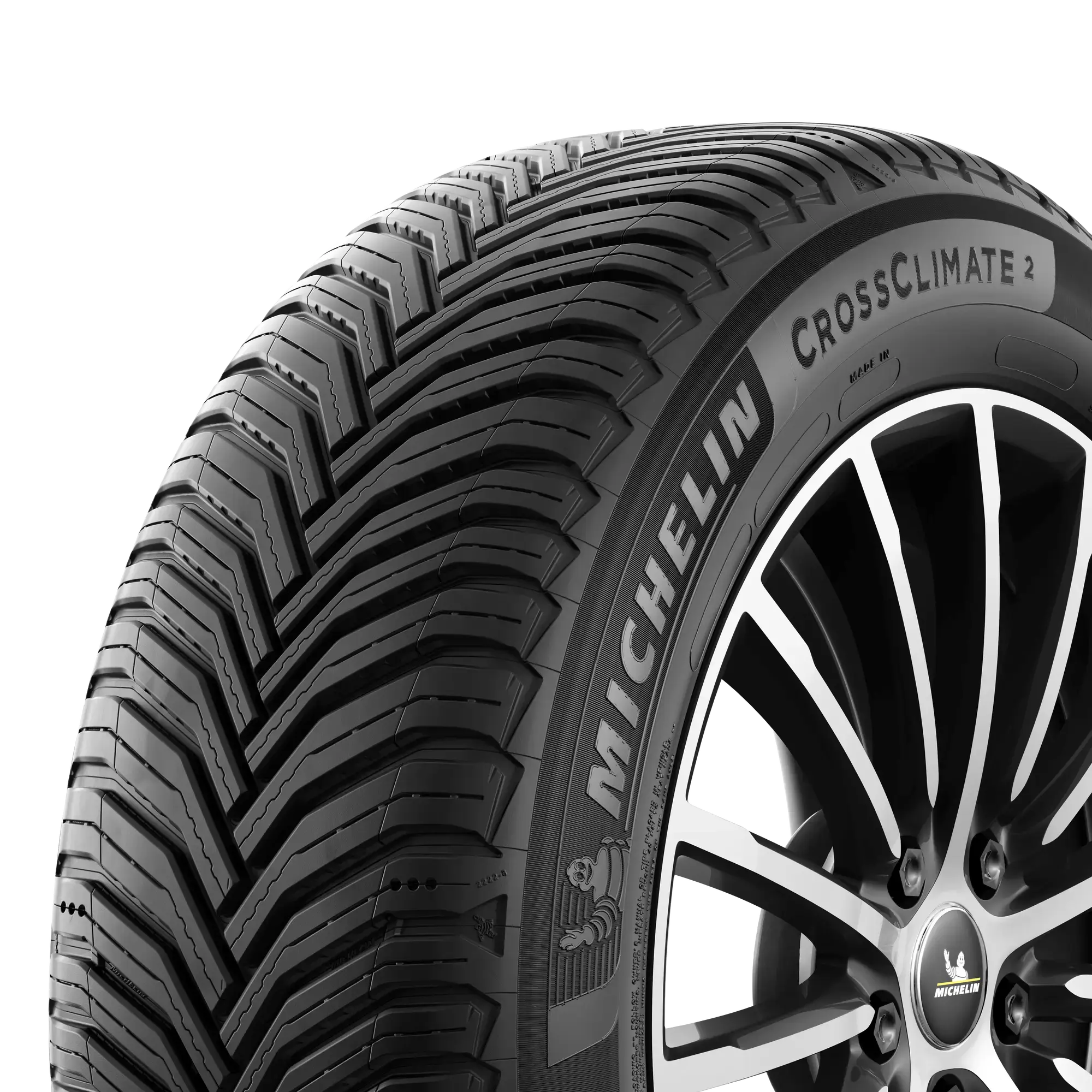
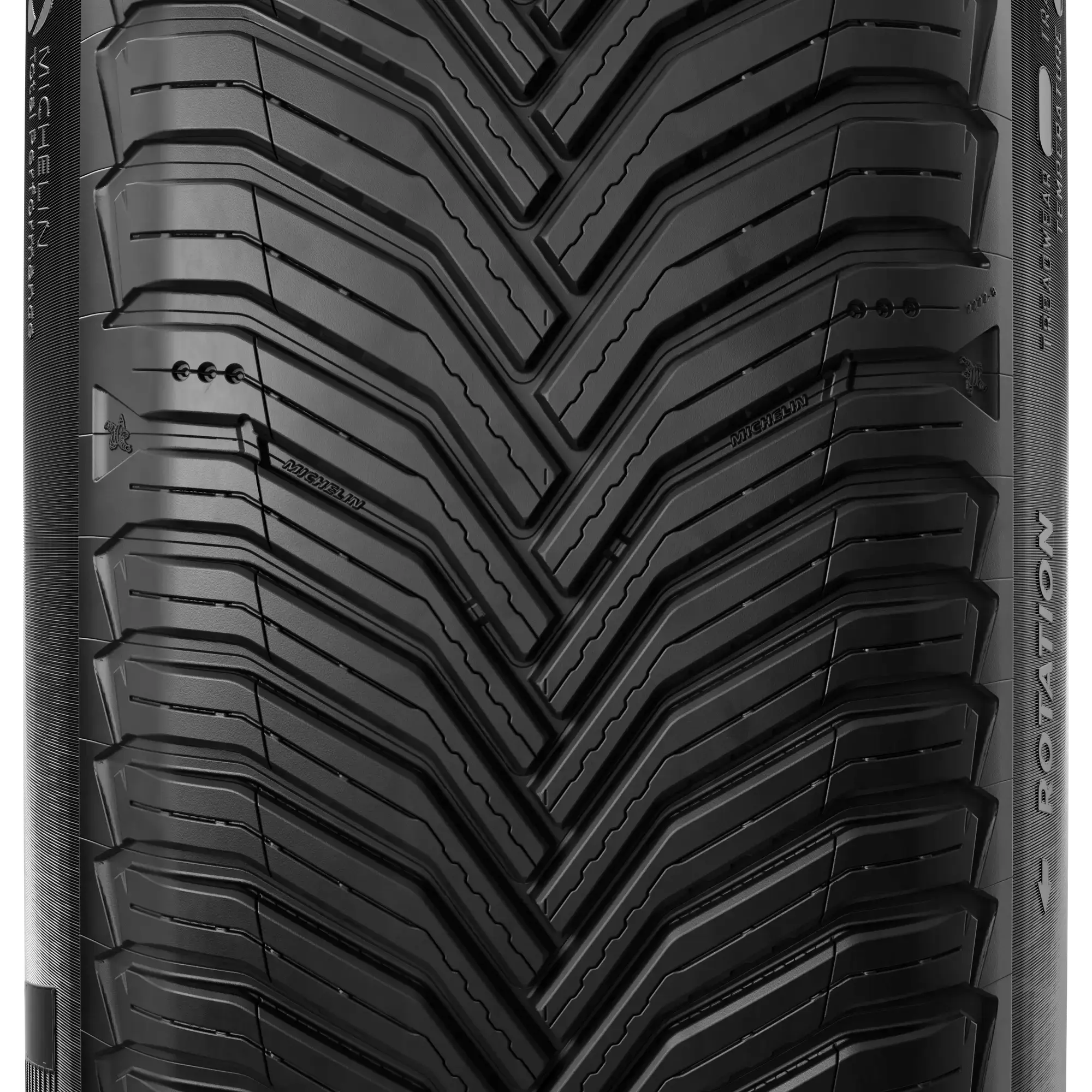
MICHELIN CrossClimate2


Proven All-Season Performance Made to Last
Michelin CROSSCLIMATE2 Designed to perform in every climate condition, with excellent wet and dry braking and up to one extra year of tread life. Proven All-Season Performance Made to Last
- Michelin CROSSCLIMATE2 all-season car, SUV, CUV and van on-road tire
- Stops shorter than 4 leading competitive tires in dry and wet conditions (1)(3)
- Lasts up to 15,000 miles longer than four leading competitors (2)
- Excellent performance in every season, even when worn (1)(4)
- Supported by the Michelin Promise Plan of a 60-day satisfaction guarantee, roadside assistance, and a 60,000-mileage warranty

Safety in all seasons
Safe driving whatever the weather, all year round
3PMSF certified
Compliant with local winter legislation requirements
Excellent Stopping Power
Stops shorter than 4 leading competitive tires in dry and wet conditions (1)(3)
MICHELIN

Key benefits for MICHELIN CrossClimate2 tire
Excellent Stopping Power
On wet pavement when worn, the Michelin CrossClimate2 tire stopped up to 56 feet shorter than four leading competitive tires. (1)

Testimonials
MICHELIN CrossClimate2 Warranties
We've got your back. A promise of this magnitude can only come from Michelin.
We want you to be 100% satisfied with your Michelin replacement passenger or light truck tires so they are backed by the Michelin Promise Plan™.
The Michelin Promise Plan™ includes the following benefits: 60-Day Satisfaction Guarantee, Roadside Assistance, Manufacturer's Limited Warranty & Treadwear Warranty.
Discover more 
CrossClimate2 TIRE REVIEW
There are 2149 reviews for the CrossClimate2

Rating Snapshot
When asked, 91% of reviewers recommend this tire
For any matter regarding customer service (in-store experience, after-sales service, delivery, etc.) please contact our Consumer Care team
Review Summary
Customers overwhelmingly praise these all-season tires for exceptional traction in wet, snowy, and icy conditions, with many reporting superior grip compared to previous winter tires. The quiet, smooth ride stands out as a major strength, with reviewers consistently surprised by the low road noise despite the aggressive tread pattern. Long-term durability impresses most, with many reporting 80,000+ miles and confidently purchasing replacement sets. A few note slight fuel efficiency decreases of 2-3 MPG or occasional vibrations at highway speeds. Overall, customers consider these tires a reliable, long-lasting investment for year-round driving.
AI-generated from the text of customer reviews
1-5 on 2149 reviews

Posted on September 14, 2026 by Henry
Collected by Bazaarvoice
I am happy with the performance of Michelin CrossClimate2 tires. Gives great, smooth, comfortable ride besides excellent grip and traction control in winter snowy condition. This is the 2nd set of 4 CrossClimate2 tires I bought for my 2013 Toyota Camry XLE Hybrid sedan.
Design
Safety
Performance
Vehicle Make: Toyota Camry, XLE, Hybrid
Purchase date: 09/10/26
Posted on September 14, 2026 by cs
Collected by Bazaarvoice
lots quieter than my old coopers
Vehicle Make: buick envision
Purchase date: 09/14/26
Posted on September 14, 2026 by dona
Collected by Bazaarvoice
Very smooth, handles great
Vehicle Make: Honda Accord
Purchase date: 09/10/26
Posted on September 13, 2026 by Little Lu
Collected by Bazaarvoice
Michelin Cross Climate
Good handling but hate them as were told these were quiet tires and they are soooo noisy it drives us crazy. Would never buy these again and stuck with expensive tires. Pretty bad when you can’t stand to drive our Toyota Rav 4 because of the noisy tires.
Posted on: michelin.com
We understand how disappointing excessive tire noise can be, especially when it impacts your driving experience. Tire noise can vary based on vehicle set up, road surfaces, inflation pressure and alignment. We recommend having the tires inspected by an authorized tire dealer to determine the cause and discuss any available options. If you have any questions or would like to discuss further, please give our Consumer Care team a call at 888-871-4444 (Mon–Fri 8 AM–7 PM EST, Sat 9 AM–1 PM EST).
michelin.com
September 14, 2026
Posted on September 13, 2026 by TireGuru
Collected by Bazaarvoice
Significant Upgrade Over OEM Tires
Significantly improved the road noise and handling on my Subaru Forester.
Vehicle Make: Subaru Forester
Purchase date: 08/26/26
Michelin answers your questions
Find quick, reliable answers to your most common questions about Michelin tires on our FAQ page.
FAQ
Performance that lasts has always been a core performance of Michelin tires. Long Lasting tires provide not only longevity but also robustness and safety until the end of life (until the legal tread wear limit). Eco-friendly driving depends notably on driving habits, vehicle, or tire pressure.
Michelin CrossClimate2 is an all-season tire, dedicated to drivers who are looking for safety in all weathers, all year round. It offers safety and mobility on dry, wet and snow, from the first to the last mile. The Michelin CrossClimate tire range is winter certified (3 Peaks Mountain Snowflake (3PMSF) marking).
Michelin CrossClimate2 tire is the leader for snow braking and traction (1)(4) and leader in wet and snow performance at the legal wear limit. (1)(4) Michelin CrossClimate2 tire has the 3PMSF marking. It is suitable for all weather conditions, all year round, including if you drive in occasional winter conditions. But if you drive often on snow covered and icy roads at winter temperatures, Michelin winter tires could be a solution to consider.
Yes, Michelin CrossClimate2 tire is a directional tire.
Michelin CrossClimate2 tire has been developed to improve several properties and offers a better overall performance (safety new and worn, rolling resistance) compared to its predecessor Michelin CrossClimate +; as a Michelin tire it also offers an excellent longevity (6).
Mixed mounting is not possible on the same axle, but rear/front mix is possible.
Our latest summer, winter, and all-season tire ranges, designed to offer high level of longevity and performance that lasts remain compliant with your electric or hybrid car. Find your perfect Michelin tire with our tire selector.
The Michelin CrossClimate3 tire launched in Europe in July 2025. Please note that the CrossClimate tires sold in Europe differ in design from those sold in North America. This is because consumers in each market have different priorities for tire performances based on driving style, vehicle types, geography, and climate. As a result, Michelin has tailored the tire construction to meet the unique needs of both regions. While the CrossClimate3 tire has been available in Europe since July 2025, North America will continue with the Michelin CrossClimate2 tire for the next several years. As a part of the Most Awarded tire brand in the U.S., the Michelin CrossClimate2 tire continues to offer industry leading performance and is designed to perform in all weather conditions, with excellent wet and dry braking. Based on our internal testing, the Michelin CrossClimate2 tire outlasted 10 different competitors and also lasts nearly 2 years longer than the new Goodyear Assurance WeatherReady®2 tire.(8)(10)
Legal Mentions
1 Based on internal wet braking tests from 50 MPH using tires buffed to 3/32" remaining tread depth, in size 235/55R18 on a 2020 Toyota RAV4 where the Michelin CrossClimate2 tire had an average stopping distance of 142.9 ft against Continental® CrossContact™ LX25 with an average stopping distance of 195.8 ft and the Goodyear® Assurance® WeatherReady® with an average stopping distance of 198.6 ft; and in size 215/55R17 on a 2019 Toyota Camry where the Michelin CrossClimate2 tire had an average stopping distance of 181.0 ft versus the Bridgestone® Turanza™ QuietTrack™ with an average stopping distance of 216.2 ft and the Continental® PureContact™ LS with an average stopping distance of 227.8 ft. Actual on-road results may vary.2 Based on U.S. Department of Transportation Average Annual Miles per driver (13,500 miles). Treadwear test performed in size 235/55R18 on 2020 Chevrolet Equinox vehicles where the Michelin CrossClimate2 showed an estimated life (based on calculating the most-worn groove of a rotated set) of 67,300 miles versus the Continental® CrossContact™ LX25 at 58,100 miles and the Goodyear® Assurance® WeatherReady® at 52,000 miles; and tested in size 215/55R17 on 2016 Toyota Camry vehicles were the Michelin CrossClimate2 tire showed an estimated life (based on calculating the most-worn groove of a rotated set) of 61,100 miles versus the Bridgestone® Turanza™ QuietTrack™ at 47,300 miles and the Continental® PureContact™ LS at 54,700 miles. Actual on-road results may vary.3 Based on internal dry braking tests from 60 MPH using tires in size 235/55R18 on a 2020 Toyota RAV4 where the Michelin CrossClimate2 tire had an average stopping distance of 113.0 ft against Continental® CrossContact™ LX25 with an average stopping distance of 121.1 ft and the Goodyear® Assurance® WeatherReady® with an average stopping distance of 129.8 ft; and in size 215/55R17 on a 2019 Toyota Camry were the Michelin CrossClimate2 tire had an average stopping distance of 115.3 ft versus the Bridgestone® Turanza™ QuietTrack™ with an average stopping distance of 124.2 ft and the Continental® PureContact™ LS with an average stopping distance of 120.4 ft. Actual on-road results may vary.4 Based on third-party snow traction tests using ASTM Test Method F1805-12, using tires buffed to 3/32" remaining tread depth. When compared to Standard Reference Test Tire (SRTT), in size 235/55R18 the Michelin CrossClimate2 tire scored 93 compared against the Continental® CrossContact™ LX25 tire which scored 63 and the Goodyear® Assurance® WeatherReady® tire which scored 65; and when compared to SRTT, in size 215/55R17 the Michelin CrossClimate2 tire scored 90 when compared against the Bridgestone® Turanza™ QuietTrack™ which scored 62 and the Continental® PureContact™ LS which scored 59. Actual on-road results may vary.5 Based on third-party snow traction tests using ASTM Test Method F1805-12 in tire size 235/45R18 versus the Goodyear ElectricDrive GT tire and the Pirelli P ZERO ALL SEASON Plus ELECT tire. Actual on-road results may vary.6 Based on internal wet braking tests from 50 mph versus the Goodyear ElectricDrive GT tire and the Pirelli P ZERO ALL SEASON Plus ELECT tire in tire size 235/45R18, using a 2020 Tesla Model 3. Actual on-road results may vary.7 Based on internal rolling resistance testing using the standard ISO 28580 method in tire size 235/45R18 XL comparing the Michelin CrossClimate 2 tire (8.80 kg/ton) versus the Goodyear ElectricDrive GT tire (8.94 kg/ton) and Pirelli P ZERO ALL SEASON Plus ELECT tire (8.28 kg/ton). Considering a 2022 Tesla Model 3 RWD fitted with size 235/45R18 tires, a battery capacity of 57.5kWh, and an autonomy of 438km (272mi), under the Worldwide Harmonized Light Vehicles Test Procedure (WLTP) test conditions, this gap of .14 kg/ton (for Goodyear) and -.52 kg/ton (for Pirelli) equates to autonomy within 2.3% of the longest range (Pirelli). Actual on-road results may vary.8 Based on U.S. Department of Transportation Average Annual Miles per driver (13,500 mi) and Desrosiers Automotive Consultants estimate of average annual kilometers driven in Canada (23,000 km). In treadwear test using tires in size 235/60R18 107V on 2018 Honda CR-Vs, the Michelin CrossClimate2 tire showed an estimated life (based on calculating the most-worn groove of a rotated set) of 79,098 miles versus the Goodyear® Assurance WeatherReady2® tire at 56,082 miles. Actual on-road results may vary.9 Based on U.S. Department of Transportation Average Annual Miles per driver (13,500 miles) and on a treadwear test using tires in size 235/55R18 on a 2020 Chevrolet Equinox and in size 215/55R17 on a 2016 Toyota Camry, versus the following competitors. Actual on-road results may vary.10 In treadwear tests using tires in size 225/60R18 100H on 2018 Honda CR-Vs, the Michelin CrossClimate2 tire showed an estimated life (based on calculating the most worn groove of a rotated set) of (a) 77,590 miles versus the Bridgestone® WeatherPeak® tire at 41,127 miles, Pirelli®Scorpion WeatherActive® tire at 58,729 miles, and Hankook Kinergy 4S2 tire at 50,312 miles, and (b) 89,337 miles versus the Vredestein®QuatracPro® tire at 41,079 miles. In a treadwear test using tires in size 235/60R18 107V on 2018 Honda CR-Vs, the Michelin CrossClimate2 tire showed an estimated life of 79,098 mi. versus the Goodyear® WeatherReady2® tire at 56,082 miles, Nokian®Remedy WRG5® tire at 45,112 miles, Falken®Aklimate® tire at 48,562 miles, and Hankook®WeatherFlex GT® tire at 55,613 miles. In a treadwear test using tires in size 235/55R18 100H on 2019 Chevrolet Equinox, the Michelin CrossClimate2 tire showed an estimated life of 73,940 miles versus the Firestone® WeatherGrip® tire at 45,355 miles. In a treadwear test using tires in size 215/55R17 94V on 2016 Toyota Camry, the Michelin CrossClimate2 tire showed an estimated life of 64,236 miles versus the Toyo®Celsius® tire at 41,053 miles. Actual on-road results may vary.
V-Speed Rated Sizes:
Light Vehicles Test Procedure (WLTP) test conditions, this gap of .14 kg/ton (for Goodyear) and -.52 kg/ton (for Pirelli) equates to autonomy within 2.3% of the longest range (Pirelli). Actual on-road results may vary.
XL = Extra Load
>> The sizes shown are average design values for tires measured on specified measuring rim widths. Some tires may vary from this value by +/-3% of the section height (affecting overall diameter), and +/-4% of the section width.
>> Section width varies approximately 0.2" (5mm) for every 0.5" change in rim width.
>> Tread patterns are often tuned to accomodate different tire widths. Tires for a particular dimension of a given tireline may vary in appearance from the tire shown in the photograph.
WARNING: Serious or fatal injury may result from tire failure due to underinflation or overloading. To ensure correct air pressure and vehicle load, refer to vehicle owner's manual or tire information placard on the vehicle. Serious injury or death may result from explosion of tire/rim assembly due to improper mounting. Only tire professionals should mount tires and they should never inflate beyond 40 psi to seat the beads. Before mixing types of tires in any configuration on any vehicle, be sure to check the vehicle owner's manual for its recommendations.
DANGER: Never mount a 16" diameter tire on a 16.5" rim.
DANGER: Never mount a 17" diameter tire on a 17.5" rim.
DANGER: Never mount a 19" diameter tire on a 19.5" rim.
DANGER: Never mount a 22" diameter tire on a 22.5" rim.
Inflation pressure increase must not exceed the maximum pressure branded on the tire sidewall. When a customer requests a replacement tire with a lower speed rating than the original equipment tire, you must clearly communicate to him or her that the handling of the vehicle may be different, and that its maximum speed capability is limited to that of the lowest speed-rated tire on the vehicle. Exceeding the lawful speed limit is neither recommended nor endorsed.
For high-speed driving, additional inflation pressure and possibly reduced tire loading and/or upsizing is required. In the absence of specific recommendations by the vehicle manufacturer, use the following guidelines based on those in the European Tyre and Rim Technical Organization Standards Manual.
For speeds over 160mph (100 mph), load and inflation must be adjusted according to the table below.
H-Speed Rated Sizes:
| Maximum Speed (mph) | 100 | 106 | 112 | 118 | 124 | 130 |
| Inflation Increase (psi) | 0.0 | 1.0 | 2.0 | 3.0 | 4.0 | 5.0 |
| Load Capacity (% of max.) | 100 | 100 | 100 | 100 | 100 | 100 |
| Maximum Speed (mph) | 100 | 106 | 112 | 118 | 124 | 130 | 136 | 143 | 149 |
| Inflation Increase (psi) | 0 | 1 | 2 | 3 | 4 | 5 | 5 | 5 | 5 |
| Load Capacity (% of max.) | 100 | 100 | 100 | 100 | 100 | 100 | 97 | 94 | 91 |
The images presented are provided for reference purposes only and do not constitute a contractual representation. They are used for illustration purposes and do not guarantee the exact conformity of the products or services offered.